
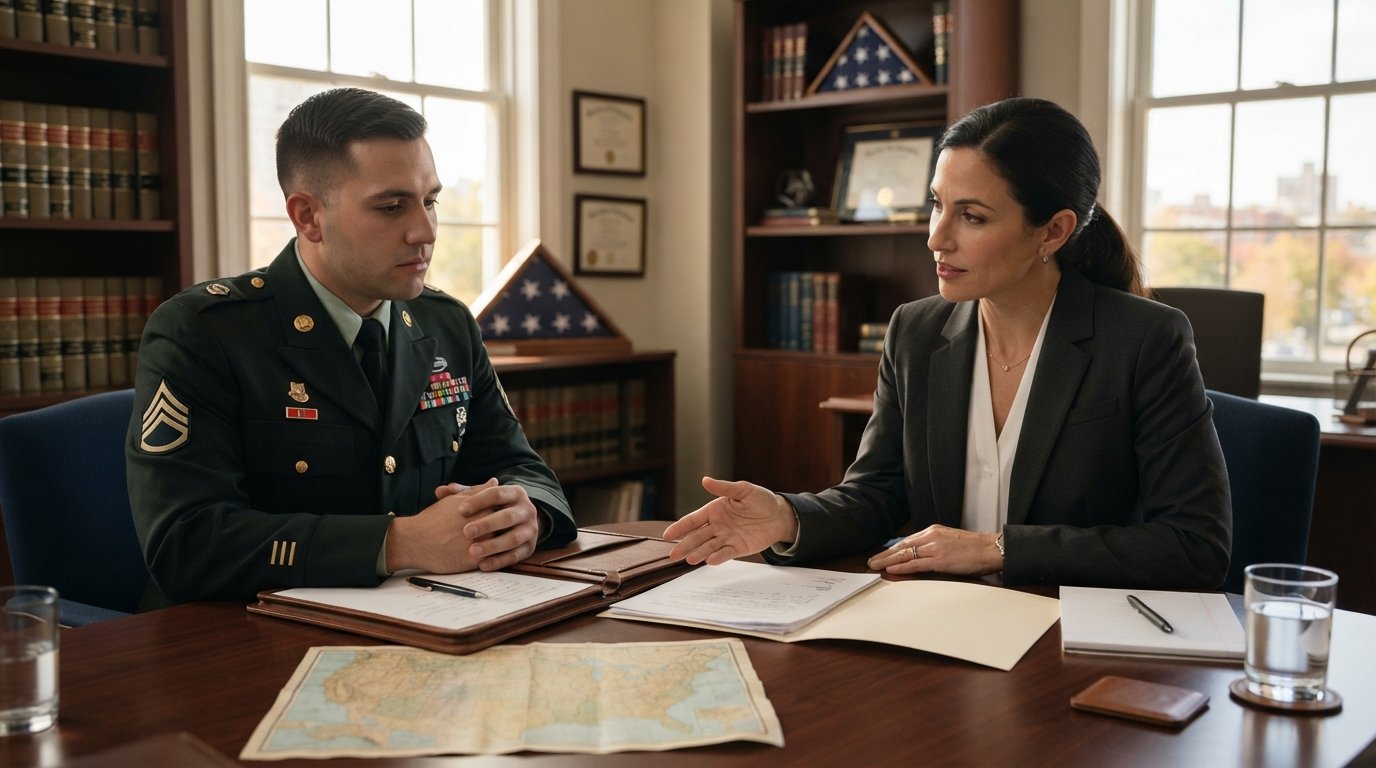
Military Service and Child Custody Jurisdiction
Military service changes custody and divorce jurisdiction rules. Get clarity on home state, SCRA protections, and pension division. Call (833)-248-4565 for a free case review.

When a service member faces divorce or a custody dispute, the legal questions multiply fast. Which state's court has the power to decide? Can a deployment change an existing parenting plan? What happens if the military orders you to move across the country in the middle of a case? These are not abstract concerns. They affect real families every day, and the answers depend on a mix of state law, federal statutes, and the unique facts of military life. Understanding how military service affects child custody and divorce jurisdiction is essential before you file anything or respond to a petition. The stakes are high: a court that lacks jurisdiction cannot make a binding order, and a default judgment entered while you are deployed can haunt you for years.
The core legal principle is simple to state but hard to apply: jurisdiction over children and over the divorce itself is governed by residency, domicile, and the child's home state. Military service scrambles each of those concepts. A service member may be stationed in one state, keep a home of record in another, and have a spouse and children living in a third. Meanwhile, the Servicemembers Civil Relief Act (SCRA) provides federal protections that can pause or delay civil proceedings, including divorce and custody cases. This article walks through the key rules, the practical steps to protect your rights, and the ways a military pension and benefits fit into the picture.
Home State and the Six-Month Residency Rule for Custody Jurisdiction
Child custody jurisdiction in the United States is primarily governed by the Uniform Child Custody Jurisdiction and Enforcement Act (UCCJEA), which every state except Massachusetts has adopted in some form. The UCCJEA establishes a hierarchy of grounds for jurisdiction. The top priority is the child's "home state," defined as the state where the child lived with a parent or a person acting as a parent for at least six consecutive months immediately before the commencement of the proceeding. For very young children, the home state is the state where the child lived from birth.
Military service complicates the home state analysis in several ways. First, a service member's legal residence (domicile) may remain in a state where they have not physically lived for years. Many states allow active-duty service members to retain their home state for divorce jurisdiction even if they are stationed elsewhere, but that rule does not automatically extend to child custody. For custody, courts look at where the child actually lived. If the child has been living with one parent in a particular state for six months or more, that state likely has home state jurisdiction, regardless of where the service member is stationed.
Second, the six-month clock can be interrupted by deployment or a permanent change of station (PCS). Suppose a service member and child move to a new state for a new assignment, but the service member deploys three months later and the child moves back to the prior state with the other parent. The child's home state may remain the prior state if the child lived there for six consecutive months at some point in the past and the other parent still resides there. The UCCJEA also allows a court to decline jurisdiction if another state is a more convenient forum, but that is a discretionary call that requires a formal motion.
Third, the UCCJEA includes a special provision for military families: a parent's absence due to military service does not alone change the child's home state. In other words, if a service member is deployed but the child remains in the same state with the other parent or a caregiver, the child's home state does not shift merely because the service member is away. This provision is designed to prevent a parent from forum shopping during a deployment.
What does this mean in practice? If you are a service member and you want a court in your current duty station to handle custody, you need to show that the child has lived there for at least six months, or that no other state qualifies as the home state and the child has a significant connection to your state. If the child has been living with the other parent in another state for six months or more, that state will likely be the proper forum. Filing in the wrong court can lead to dismissal, delay, and wasted legal fees.
There is one more wrinkle: the UCCJEA gives priority to the court that first makes a custody determination, and that court retains exclusive, continuing jurisdiction until it determines that neither the child nor either parent has a significant connection to the state. Military families move often, so this continuing jurisdiction rule can keep a case in a state where no one currently lives. If you are facing a custody dispute and the child's home state is unclear, a free case evaluation with an attorney experienced in military family law can help you identify the proper forum before you file. You can also read our guide on comparative negligence and how fault affects a claim for context on how fault principles sometimes intersect with family law proceedings.
Servicemembers Civil Relief Act Protections Against Default Judgments
The SCRA is a federal law that provides a wide range of protections for active-duty service members in civil proceedings, including divorce and custody cases. One of the most important protections is the stay of proceedings. Under the SCRA, a service member who is on active duty, or who was on active duty within 90 days before the proceeding began, may request a stay of the proceedings for at least 90 days if the service member's ability to appear is materially affected by military service. The court must grant the stay if the request meets the statutory requirements, unless the court finds that the service member's ability to appear is not materially affected.
The SCRA also protects against default judgments. If a plaintiff files a divorce or custody case and the service member defendant does not respond, the court cannot simply enter a default judgment. The plaintiff must file an affidavit stating whether the defendant is in military service and, if so, the defendant's address. If the defendant is in military service, the court must appoint an attorney to represent the defendant before entering a default judgment. The court may also grant a stay of proceedings if the appointed attorney requests one. These protections are designed to ensure that service members are not blindsided by legal actions while they are deployed or otherwise unable to respond.
Consider a common scenario: a service member is deployed overseas and receives divorce papers. The service member cannot appear in court, cannot access legal resources easily, and may not even know the case is proceeding. Without the SCRA, the court could enter a default judgment dividing property, awarding custody, and ordering support, all without the service member's input. The SCRA prevents that outcome by requiring the court to take extra steps to protect the service member's rights. However, the SCRA is not automatic. The service member must invoke its protections by filing a request for a stay or by notifying the court of their military status. If you are a service member facing a family law case, do not ignore the paperwork. Contact a military legal assistance office or a civilian attorney immediately.
For spouses of service members, the SCRA can feel like a roadblock. A spouse who wants to finalize a divorce may face delays while the service member is deployed. But the SCRA does not give service members a permanent shield. It provides temporary protections that are tied to the period of military service. Once the service member returns and has a reasonable opportunity to appear, the case can proceed. Spouses should document their attempts to serve the service member and work with an attorney to ensure the case moves forward efficiently once the SCRA stay expires.
Deployment and Parenting Plan Modifications
Deployment is one of the most disruptive events in a military family, and it often requires changes to an existing custody or parenting plan. A parenting plan that works well when both parents are in the same state may be impossible to follow when one parent is deployed to a combat zone or stationed overseas. The key legal question is whether the deployment constitutes a substantial change in circumstances that justifies modifying the plan. Most states allow modification when there has been a material change in circumstances, and deployment can qualify if it significantly affects the child's best interests or the parent's ability to exercise parenting time.
However, courts are cautious about using deployment alone as a reason to permanently reduce a service member's custody or visitation rights. Many states have enacted protections that prohibit courts from considering a parent's military service as the sole factor in a custody determination. The Servicemembers Civil Relief Act also provides some protections for custody arrangements during deployment, though these vary by state. Some states allow a service member to delegate their parenting time to a close family member during deployment, such as a grandparent or stepparent, without that delegation being considered a permanent change. Other states require the service member to file a motion for a temporary modification.
Here are practical steps to take when facing a deployment-related parenting plan issue:
- Review the existing plan. Check whether it includes a deployment clause or a provision for temporary modifications. Many modern parenting plans include specific procedures for deployment, including notice requirements and temporary custody arrangements.
- File for a temporary modification before you deploy. If your plan does not address deployment, file a motion for a temporary modification well in advance. Courts are more likely to grant a request that is made early and with a clear plan for the child's care.
- Document your delegation plan. If you want your parenting time to be exercised by a family member while you are deployed, get a written agreement from the other parent or a court order approving the arrangement. Without documentation, the other parent may later argue that you abandoned your parenting time.
- Seek legal assistance through your military branch. Each branch offers free legal assistance to service members for family law matters, including deployment planning. Use it.
After deployment ends, the service member may need to file a motion to restore the original plan or to modify it based on the child's current circumstances. Courts generally favor restoring the status quo ante, but the child's best interests remain the paramount consideration. If the child has bonded with a new caregiver or has settled into a new routine, the court may order a gradual transition rather than an immediate return to the prior schedule. This is why early planning is critical: a well-drafted deployment plan can minimize disruption and reduce the risk of litigation.
How Military Pensions and Benefits Are Divided in Divorce
Divorce jurisdiction affects not only custody but also the division of military pensions and benefits. Military retired pay is generally treated as marital property in a divorce, but the division is governed by a complex set of federal and state rules. The Uniformed Services Former Spouses' Protection Act (USFSPA) allows state courts to divide military retired pay as marital property, but it also imposes limits and procedural requirements. The USFSPA does not create a federal right to a share of retired pay; it simply permits state courts to treat it as marital property if state law allows.
One of the most important requirements is the 10/10 rule. To receive direct payment of a share of military retired pay from the Defense Finance and Accounting Service (DFAS), the former spouse must have been married to the service member for at least 10 years during which the service member performed at least 10 years of creditable military service. If the marriage does not meet the 10/10 rule, the former spouse may still be entitled to a share of the pension, but the service member must make the payments directly, and enforcement can be more difficult.
Jurisdiction matters because the court that divides the pension must have personal jurisdiction over the service member. If the service member is stationed in one state but the divorce is filed in another, the court may lack personal jurisdiction to divide the pension. This is a common issue in military divorces, where the service member may have legal residence in one state, physical presence in another, and a spouse living in a third. The USFSPA requires that the court have jurisdiction over the service member by reason of the service member's residence, domicile, consent, or other basis consistent with the Due Process Clause. If the court lacks jurisdiction, the pension division order may be unenforceable.
Military benefits beyond retired pay also come into play. Survivor Benefit Plan (SBP) coverage, health care benefits, and GI Bill benefits may be affected by divorce. The SBP, for example, allows a service member to elect to provide an annuity to a former spouse, but the election must be made with the former spouse's consent or by court order. Health care benefits for former spouses are governed by the 20/20/20 rule (20 years of marriage, 20 years of service, and 20 years of overlap) or the 20/20/15 rule for a shorter period of overlap. These rules are technical and fact-specific, and mistakes can cost thousands of dollars over time.
If you are facing a military divorce, you need an attorney who understands both family law and military benefits. The interplay between state property division rules and federal military regulations is not intuitive. A lawyer who handles these cases regularly can help you avoid costly errors, whether you are the service member or the spouse. For general information about how legal claims are evaluated, you can visit LawyerOffer for educational resources and attorney referral options.
Practical Steps to Protect Your Rights
Military service adds layers of complexity to divorce and custody cases, but the basic steps to protect your rights are straightforward. The earlier you act, the more options you have.
Start by identifying the proper forum. Determine the child's home state under the UCCJEA and confirm whether the court has personal jurisdiction over the service member. If you are the service member, check whether your home state of record allows you to file for divorce there even if you are stationed elsewhere. If you are the spouse, confirm that the service member has sufficient contacts with the state where you plan to file.
Next, invoke SCRA protections if they apply. If you are a service member and you receive notice of a legal proceeding, do not ignore it. File a request for a stay if your ability to appear is materially affected by military service. If you are the spouse, be prepared to comply with the SCRA's requirements for default judgments, including filing the required affidavit and serving the service member properly.
Then, address deployment planning early. If a deployment is on the horizon, file any necessary motions for temporary modification before you leave. Document any delegation of parenting time and get the other parent's written agreement or a court order. Use military legal assistance offices for help with the paperwork.
Finally, get professional advice. Military divorce and custody cases involve federal statutes, state laws, and military regulations that interact in ways that are not always obvious. A consultation with an attorney who handles military family law can save you time, money, and stress. FreeLegalCaseReview.com connects individuals with qualified attorneys through a free, confidential case evaluation process. You can request a complimentary case assessment to understand your options before you commit to hiring a lawyer.
The way military service affects child custody and divorce jurisdiction is not a single rule but a web of rules that depend on residency, the child's home state, the SCRA, and the specific facts of your case. Service members and spouses who understand these rules are better positioned to avoid default judgments, protect their parenting time, and secure a fair division of military pensions and benefits. Take the time to learn the rules that apply to your situation, and do not hesitate to seek help when the stakes are high.