
How Accident Reconstruction Experts Prove Liability
Accident reconstruction experts use skid marks, black box data, and damage analysis to prove fault. Call (833)-248-4565 for a free case evaluation.

By Fable Kensington
When two drivers point fingers after a crash, the truth often hides in the details: the arc of a skid mark, the crush depth on a bumper, the data stored in a vehicle's black box. Accident reconstruction experts are the professionals who decode those details and translate them into a clear picture of what happened. Their work frequently determines who pays, how much, and whether an insurance company's initial offer is fair or far too low. If you are facing disputed fault after a collision, understanding how reconstruction evidence works can help you protect your rights and push back against a lowball settlement.
What Accident Reconstruction Experts Analyze at a Crash Scene
Accident reconstruction is the application of physics, engineering, and investigative technique to determine how a collision occurred. A reconstruction expert typically visits the scene (or reviews detailed documentation if the scene has changed), examines the vehicles, and collects physical evidence that most people would overlook. The goal is to build a timeline: vehicle positions, speeds, driver reactions, and impact forces.
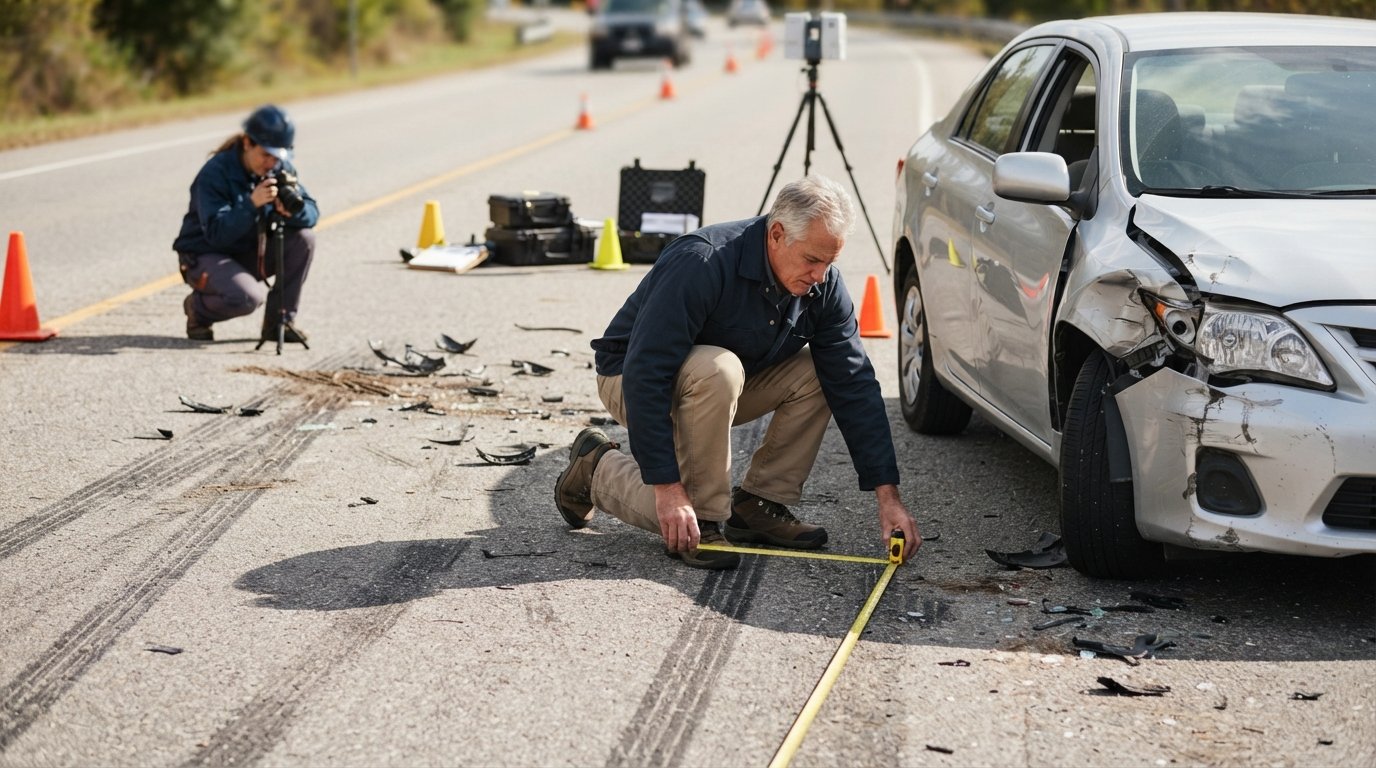
At the scene, experts document road conditions, visibility, weather, and traffic control devices. They measure skid marks, gouges, and debris fields. They photograph vehicle damage from multiple angles and note the location of final rest positions. In some cases, they use drones or 3D scanners to create a digital model of the crash site. This raw data becomes the foundation for calculations that can establish speed, braking, and avoidance opportunities.
The list below highlights the core evidence categories a reconstruction expert typically examines:
- Scene evidence: skid marks, yaw marks, debris, fluid trails, and road defects.
- Vehicle evidence: crush damage, tire condition, brake system performance, and occupant restraint use.
- Environmental evidence: weather, lighting, sight distance, and traffic signal timing.
- Digital evidence: event data recorders (black boxes), GPS, and dashboard or surveillance footage.
- Human evidence: witness statements, injury patterns, and driver reaction times.
Each category feeds into a larger analysis. For example, a skid mark length can be used to calculate pre-impact speed, while crush damage can confirm the direction and severity of impact. When these independent data points align, the reconstruction becomes far more credible to insurers, judges, and juries.
How Skid Marks, Vehicle Damage, and Black Box Data Establish Speed and Impact
Speed is often the central issue in a liability dispute. If one driver was speeding, that fact can shift fault percentages dramatically. Reconstruction experts use several methods to estimate speed, and they cross-check those methods to strengthen their conclusions.
Skid marks are one of the oldest and most reliable indicators. The length of a skid mark, combined with the friction coefficient of the road surface, allows an expert to calculate how fast a vehicle was traveling when the brakes locked. Yaw marks (curved tire marks left when a vehicle slides sideways) can reveal speed through a curve. Vehicle damage tells a complementary story: the depth and pattern of crush damage correlate with impact speed and force. Experts compare the damage on both vehicles to confirm relative speeds and impact angles.
Event data recorders, commonly called black boxes, have revolutionized reconstruction. These devices, standard in most modern vehicles, record pre-impact speed, braking, throttle position, steering angle, and seat belt status in the seconds before a crash. An expert can download this data and use it to verify or challenge witness statements. For example, if a driver claims they were traveling at the speed limit but the black box shows 15 mph over, that discrepancy can undermine their credibility and support a higher fault allocation against them.
Together, these three evidence streams (physical marks, damage analysis, and digital data) create a triangulated conclusion that is difficult to dispute. Insurance adjusters know this, which is why the mere presence of a reconstruction report often changes the tone of settlement negotiations. If you are dealing with a disputed bicycle accident, the same principles apply: reconstruction can clarify vehicle speed, sight lines, and fault. For a deeper look at fault and compensation in those cases, see our guide on bicycle accident liability and compensation options.
The Role of Reconstruction Reports in Disputes Over Fault Percentages
In many crashes, fault is not binary. Insurance companies and courts often assign comparative fault percentages: one driver may be 70 percent responsible, the other 30 percent. These percentages directly affect how much compensation a claimant can recover. A reconstruction report provides the objective evidence needed to argue for a more favorable allocation.
Consider a multi-vehicle pileup on a highway. Initial police reports might place blame on the rear driver, but reconstruction could show that a middle vehicle braked suddenly without working taillights, contributing to the chain reaction. Similarly, in a nighttime crash, reconstruction can analyze headlight performance, road lighting, and sight distance to determine whether one driver had a reasonable opportunity to avoid the collision. Without this analysis, an insurer might simply default to a convenient narrative that minimizes its policyholder's responsibility.
Reconstruction reports typically include diagrams, calculations, and clear conclusions. They may also address alternative scenarios and explain why those scenarios are inconsistent with the physical evidence. This structured approach makes the report a powerful negotiation tool. When an attorney presents a well-supported reconstruction to an adjuster, the adjuster must either rebut it with equal rigor or adjust the offer. In many cases, the insurer chooses the latter.
For claimants, the key takeaway is that fault disputes are not resolved by who argues loudest. They are resolved by evidence. A reconstruction expert turns scattered physical clues into a coherent, defensible account of the crash. That account can be the difference between a settlement that covers your medical bills and one that leaves you short.
Cost of Hiring an Expert and How It Is Handled in a Contingency Case
One of the most common concerns claimants have is the cost of hiring an accident reconstruction expert. Fees vary widely based on the complexity of the crash, the expert's credentials, and the scope of work. A basic reconstruction might cost a few thousand dollars, while a comprehensive analysis involving 3D scanning, black box downloads, and courtroom testimony can run into the tens of thousands.
However, in a contingency fee arrangement, the claimant typically does not pay these costs upfront. Personal injury attorneys who work on contingency advance the expenses of litigation, including expert fees, and are reimbursed from the settlement or verdict at the end. This means you can pursue strong reconstruction evidence without writing a check. The attorney bears the financial risk, which aligns incentives: the attorney will only invest in an expert if the case has sufficient value and the evidence is likely to make a difference.
If you are unsure whether your case warrants a reconstruction expert, a free case evaluation can help clarify your options. Platforms like CheapInjuryLawyer connect injury victims with attorneys who can assess whether expert testimony is necessary and explain how costs are handled. Many personal injury attorneys offer contingency arrangements, so you can focus on recovery while your legal team builds the evidence.
It is also worth noting that not every case needs a full reconstruction. For straightforward rear-end collisions with clear liability, police reports and medical records may suffice. But when fault is disputed, when injuries are severe, or when the insurance company is playing hardball, the investment in an expert often pays for itself many times over.
When Reconstruction Matters Most: Multi-Vehicle and Nighttime Crashes
Reconstruction evidence is valuable in any disputed crash, but certain scenarios make it indispensable. Multi-vehicle accidents are a prime example. With multiple drivers, multiple insurance policies, and conflicting statements, determining who hit whom and in what order is critical. Reconstruction can sequence the impacts, identify the initiating event, and clarify each driver's contribution. Without it, claimants risk being assigned fault they do not deserve.
Nighttime crashes present unique challenges: reduced visibility, fatigued drivers, and often no independent witnesses. Reconstruction experts analyze lighting conditions, headlight functionality, and road geometry to determine what each driver could reasonably have seen and when. They can also use black box data to check whether a driver braked before or after the impact, which speaks to attention and reaction time. In pedestrian and bicycle accidents at night, this analysis can be decisive.
Other situations where reconstruction often proves liability include:
- Crashes involving commercial trucks, where electronic logging devices and weigh station data add another layer of evidence.
- Accidents on construction sites or in work zones with altered traffic patterns.
- Claims of sudden unintended acceleration or mechanical failure.
- Hit-and-run collisions where vehicle paint transfer or debris can link a suspect vehicle to the scene.
In each of these cases, the reconstruction expert serves as an objective interpreter of physical evidence. Their findings can cut through competing narratives and give your attorney a solid foundation for negotiations or trial.
Building a Strong Liability Case with Reconstruction Evidence
Proving liability after an accident is rarely as simple as exchanging insurance information. Insurance companies have teams of adjusters and attorneys whose job is to minimize payouts. To level the playing field, you need evidence that is difficult to dispute. Accident reconstruction experts provide exactly that: a scientific, methodical analysis that can withstand scrutiny.
If you are considering a claim, start by preserving evidence. Do not repair your vehicle until an expert has had a chance to inspect it. Keep photographs, medical records, and witness contact information. Then, consult with a personal injury attorney who can evaluate whether reconstruction is warranted. Many attorneys offer free consultations and work on contingency, so you can get professional guidance without financial risk.
Remember that the insurance company's initial offer is just that: an opening bid. With strong reconstruction evidence, you can negotiate from a position of strength. Whether your case involves a multi-vehicle highway pileup, a nighttime pedestrian accident, or a disputed intersection collision, the right expert can make the difference between a lowball settlement and the compensation you deserve.