
Truck Accident Claim vs Car Accident Claim: Key Differences
Truck accident claim vs car accident claim differences can determine your payout. Call (833)-248-4565 for a free case evaluation and protect your rights.

By Caleb Morrison
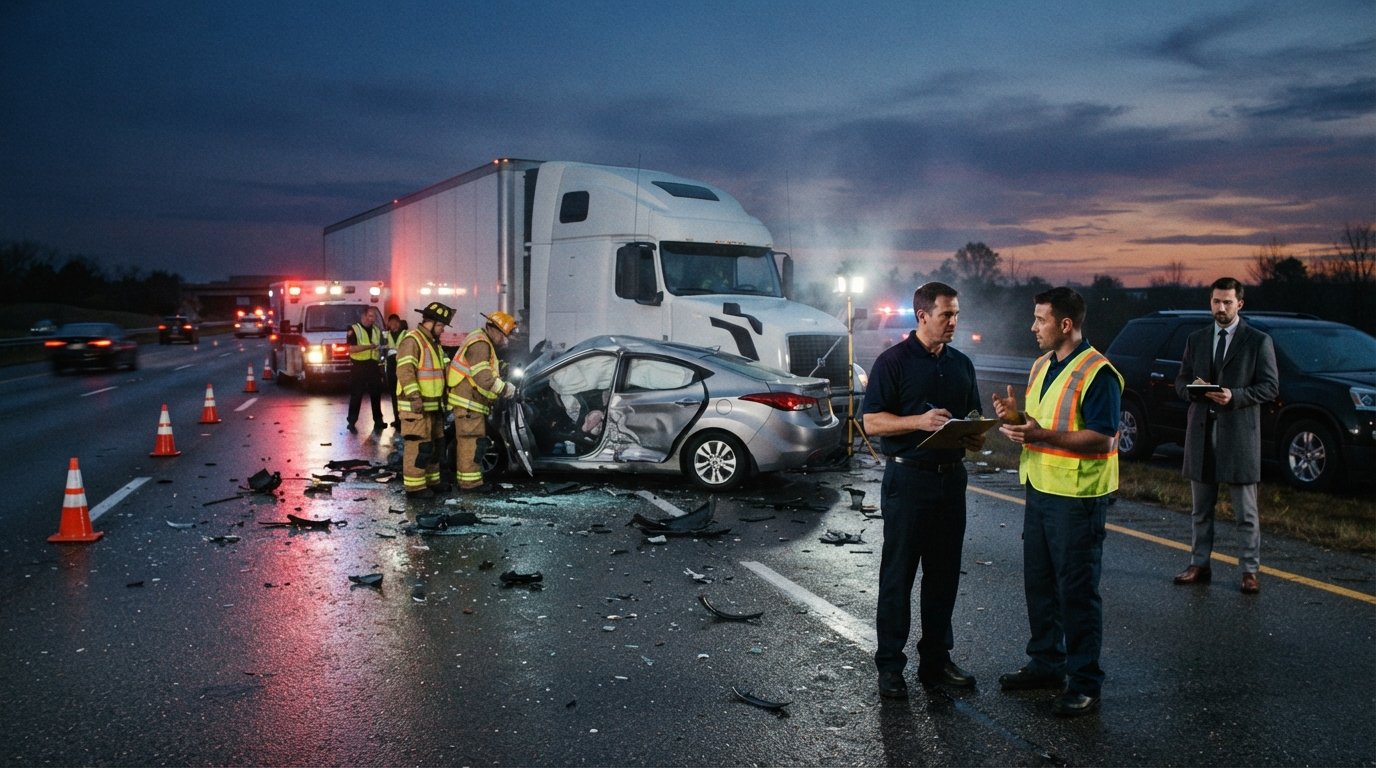
A crash involving a commercial truck rarely unfolds like a typical fender bender. The stakes are higher, the injuries are often catastrophic, and the legal battlefield is crowded with corporate insurers, fleet safety teams, and multiple liable parties. If you or a loved one has been hurt in a collision with a semi, box truck, or delivery vehicle, understanding how a truck accident claim differs from a car accident claim is the first step toward protecting your rights. The distinctions are not minor procedural quirks; they shape everything from who you sue to how quickly evidence disappears. In this guide, we break down the truck accident claim vs car accident claim differences that matter most, so you can approach your case with clarity and confidence.
Why Truck Accident Claims Operate Under Different Rules
The most fundamental difference between a truck accident claim and a car accident claim lies in the sheer scale of the parties and regulations involved. A standard car accident typically involves two individuals, each with a personal auto policy. A truck accident, by contrast, pulls in a web of commercial entities: the trucking company, the driver, the cargo loader, the maintenance contractor, and sometimes the manufacturer of a defective part. Each of these parties may carry separate insurance policies with limits far exceeding a typical auto policy.
Commercial trucks are also governed by a dense layer of federal and state regulations. The Federal Motor Carrier Safety Administration (FMCSA) sets rules on driver hours, vehicle maintenance, drug testing, and electronic logging devices. When a trucking company violates these rules, that violation can become powerful evidence of negligence. In a car accident case, there is no equivalent federal oversight. This regulatory dimension alone makes truck accident claims more complex and, often, more valuable.
Another critical distinction is the timeline. Trucking companies are required to preserve certain records, but those records can be destroyed or overwritten quickly. Electronic control module data, driver logs, and dashcam footage may vanish within weeks if not formally requested. A car accident claim rarely involves this kind of urgent evidence preservation. If you are unsure how to proceed when liability is unclear, our guide on what to do if fault is disputed offers a useful starting point for protecting your position.
Insurance Dynamics: Commercial Policies vs Personal Auto Policies
Insurance is where the truck accident claim vs car accident claim differences become painfully practical. A personal auto policy typically carries liability limits of $25,000 to $100,000 per person, depending on the state. A commercial trucking policy, however, is often $750,000 to $5 million or more, as required by federal law for interstate carriers. This means the at-fault party in a truck accident usually has far more coverage available to compensate victims, but the insurer also has far more resources to fight your claim.
Commercial insurers employ specialized adjusters who handle trucking claims exclusively. They understand the regulations, they know how to shift blame, and they often arrive at the scene faster than local police. They may try to get you to sign a quick settlement before you understand the full extent of your injuries. In a car accident claim, the adjuster is more likely a generalist handling dozens of different case types.
This disparity in resources is why many victims of truck accidents benefit from early legal guidance. At LegalCaseReview, readers can explore analysis and commentary on personal injury law that helps level the playing field. The site is not a law firm, but it provides educational context that can inform your decisions.
Liability: Who Can You Sue in a Truck Accident?
In a car accident, liability usually rests with the driver who caused the crash. In a truck accident, liability can extend to multiple parties, each with their own defense team. Identifying all responsible parties is essential because it expands the pool of insurance coverage available to pay your claim. Common defendants in a truck accident case include:
- The truck driver, if they were negligent, distracted, or impaired.
- The trucking company, if it hired an unqualified driver, pushed unrealistic schedules, or failed to maintain the vehicle.
- The cargo loading company, if improperly loaded cargo shifted and caused the crash.
- The maintenance provider, if a brake failure or tire blowout resulted from shoddy repairs.
- The truck or parts manufacturer, if a defective component contributed to the accident.
Each of these parties may point fingers at the others, creating a complex web of cross-claims and counter-claims. In a car accident claim, this multi-party dynamic is rare. The practical effect is that truck accident claims often take longer to resolve because fault must be sorted out among several defendants. However, that complexity can also lead to higher settlements when a skilled attorney knows how to leverage the evidence.
Evidence Collection and Spoliation Concerns
Evidence in a truck accident case is both more abundant and more fragile than in a car accident case. Trucks are rolling data centers. They contain electronic logging devices, GPS trackers, engine control modules, and often inward- and outward-facing cameras. These systems record speed, braking, hours of service, and driver behavior in the moments before impact. That data can be decisive in proving negligence.
The problem is that trucking companies are not obligated to preserve this data indefinitely. Federal rules require retention for a period, but once that period ends, the data may be overwritten or deleted. If you wait too long to involve an attorney, you may lose access to the very evidence that could make your case. A spoliation letter, sent early, formally demands that the trucking company preserve all relevant records. In a car accident claim, evidence is usually limited to police reports, witness statements, and vehicle damage photos.
This urgency is one of the most important truck accident claim vs car accident claim differences. If you suspect the trucking company has already destroyed evidence, an experienced attorney can file a motion for sanctions or ask the court to presume negligence. But the burden is on you to act quickly.
Injury Severity and Damage Calculations
The physics of a truck accident almost guarantee more severe injuries than a car accident. A fully loaded semi can weigh 80,000 pounds, while a passenger car weighs around 4,000 pounds. The force of impact is exponentially greater, leading to traumatic brain injuries, spinal cord damage, internal organ trauma, amputations, and wrongful death. These catastrophic injuries require long-term medical care, rehabilitation, and sometimes lifelong assistance.
When calculating damages, truck accident claims often involve higher economic losses: past and future medical bills, lost earning capacity, home modifications, and attendant care. Non-economic damages for pain, suffering, and loss of enjoyment of life are also typically larger. In a car accident claim, injuries may be softer (whiplash, minor fractures) and damages more modest. Insurance adjusters know this, which is why they often try to settle truck accident claims quickly before the full extent of injuries is known.
If you are facing mounting medical bills and pressure from insurers, a free case evaluation can help you understand the true value of your claim. Platforms like FreeLegalCaseReview.com connect victims with top attorneys who can assess your damages and negotiate from a position of strength.
Statutes of Limitations and Notice Requirements
Both truck and car accident claims are subject to statutes of limitations, which set a deadline for filing a lawsuit. These deadlines vary by state, typically ranging from one to three years. However, truck accident claims may involve additional notice requirements. If a government entity owns the truck (for example, a city bus or municipal garbage truck), you may need to file a notice of claim within 60 to 180 days. Missing this deadline can bar your claim entirely.
Interstate trucking companies may also be subject to federal filing requirements or contractual notice provisions. A car accident claim rarely involves these extra layers. Failing to meet a deadline is one of the most common reasons victims lose their right to compensation. This is why consulting an attorney early is critical, even if you are not sure you want to sue.
How Comparative Negligence Applies Differently
In many states, comparative negligence rules reduce your recovery by your percentage of fault. If you were 20% at fault for a car accident, your compensation is reduced by 20%. The same principle applies in truck accidents, but the analysis is more nuanced. Trucking companies often try to shift blame to the victim, claiming the driver cut them off or braked suddenly.
Because truck accident cases involve multiple defendants, comparative fault can become a battleground. Each defendant may blame the others, and the victim may be caught in the middle. An attorney who understands trucking regulations and accident reconstruction can counter these arguments effectively. In a simple car accident, comparative fault is usually a two-party dispute.
When to Seek Legal Help for a Truck Accident Claim
Given the complexities outlined above, it is wise to consult an attorney as soon as possible after a truck accident. The insurance company may contact you within days, offering a settlement that seems generous but fails to cover future medical needs. An attorney can send spoliation letters, gather evidence, and deal with adjusters on your behalf.
For those who are not ready to hire a lawyer, a free case evaluation through FreeLegalCaseReview.com can provide clarity without obligation. The platform uses a patented attorney selection process to match victims with top-rated legal professionals. There is no cost to request an evaluation, and you retain control over whether to proceed.
Remember, truck accident claim vs car accident claim differences are not just academic. They affect how quickly you must act, who you can sue, and how much you can recover. Understanding these differences empowers you to make informed decisions during a stressful time.
If you have been injured in a collision with a commercial truck, do not navigate the process alone. The right legal guidance can mean the difference between a lowball settlement and full compensation for your injuries. Reach out today to explore your options and protect your future.