
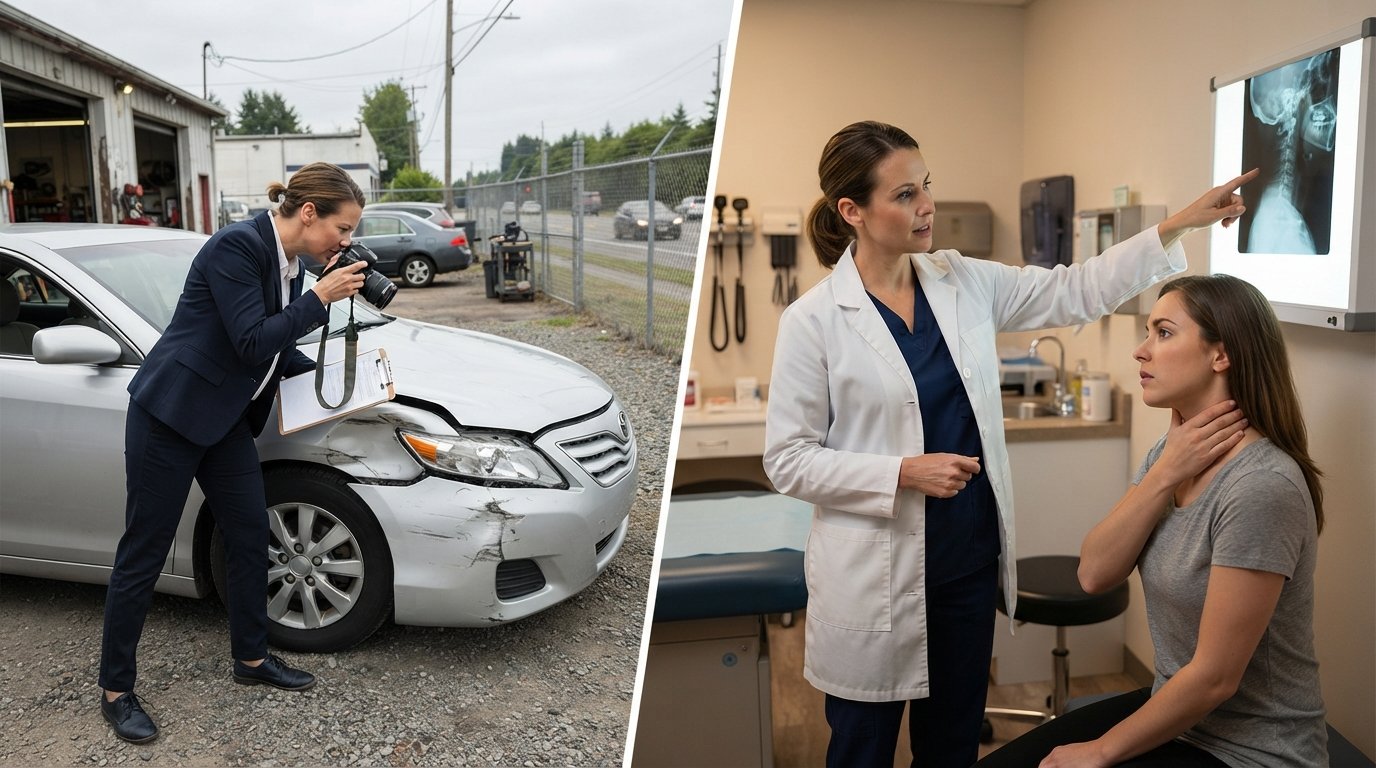
Property Damage vs Injury Claims: One Accident, Two Paths
Property damage and injury claims differ in one accident: separate timelines, releases, and risks. Call (833)-248-4565 for a free case evaluation.

After a car crash, you might assume the insurance company will handle everything as a single matter. In reality, one accident typically produces two distinct claim tracks: one for property damage and one for bodily injury. Understanding how property damage and injury claims differ in one accident is critical because the two are evaluated, negotiated, and often paid on completely different timelines. Insurers may rush to settle your vehicle damage while your injury claim remains open, and a misstep in one area can quietly undermine the other. This article breaks down the separation, the risks, and the practical steps to protect both sides of your claim.
Why Insurers Settle Property Damage Before Injury Claims
Insurance adjusters often move quickly on property damage because the scope is relatively objective. A repair estimate, a police report, and photos of the vehicle establish a fairly clear picture of what it costs to fix or replace the car. Injury claims, by contrast, involve medical uncertainty: soft tissue injuries may not fully manifest for days, treatment can continue for months, and long-term prognosis is often unknown. Insurers know that settling the property damage early closes one file and reduces administrative load, but they also know that a quick property damage settlement can create leverage against the injury claim.
There is another reason for the timing gap. Property damage payments are typically made under the collision or property damage liability coverage, which has a defined policy limit. Injury claims may involve multiple coverages, including bodily injury liability, medical payments, and uninsured motorist coverage. The adjuster handling your car repair may not even be the same person handling your injury claim. This separation is standard practice, but it means you must track both processes independently and avoid assuming that a property damage settlement resolves anything beyond the vehicle.
Consider a common scenario: you are rear-ended, your bumper and trunk are crushed, and you feel sore but assume it will pass. The other driver's insurer offers a property damage check within a week. If you sign a release for the property damage only, that release should be limited to the vehicle damage, but some documents are broader than they appear. Always read the release language carefully. A property damage release should not contain language that waives bodily injury claims, yet overbroad releases do appear, and signing one can jeopardize your injury case. When in doubt, have a legal professional review the document before you sign.
Total Loss Valuation Disputes and Independent Appraisals
When a vehicle is declared a total loss, the insurer pays the actual cash value (ACV) rather than the cost of repairs. This is where many property damage disputes begin. Insurers use valuation services that may rely on comparable vehicles in your area, but those comparables may not match your car's mileage, condition, trim level, or recent maintenance. The first offer is frequently lower than the true market value, and policyholders who accept it without scrutiny often leave money on the table.
You have the right to challenge a total loss valuation. The process typically involves gathering evidence and, in some cases, hiring an independent appraiser. A strong challenge starts with documentation: maintenance records, photos showing the vehicle's condition before the crash, receipts for recent repairs or upgrades, and listings for similar vehicles with similar mileage. If the insurer's comparables are far off, point out the discrepancies in writing.
Many policies include an appraisal clause that allows you to demand an appraisal when you and the insurer disagree on value. The mechanics vary by state and policy, but the general framework looks like this:
- Submit a written demand for appraisal under the policy's appraisal provision.
- Each side selects a qualified independent appraiser.
- The two appraisers attempt to agree on value; if they cannot, an umpire is selected to resolve the difference.
- The agreed or umpire-decided value becomes binding under the appraisal process.
Independent appraisals can cost a few hundred dollars, but the difference in payout can be thousands. Before invoking the clause, confirm that your policy actually contains one and that you have exhausted the insurer's internal review process. Keep in mind that the appraisal process addresses value only; it does not resolve liability disputes or injury claims. Treat it as a targeted tool for the property damage track.
How Property Damage Settlements Can Affect Injury Claims
The most misunderstood interaction between the two tracks is the release. When you settle property damage, you sign a release of claims related to the vehicle. A well-drafted release is narrow, covering only property damage. A poorly drafted or overly broad release may include language that releases all claims arising from the accident, including bodily injury. Signing such a release can extinguish your injury claim before you even realize its value.
There is also an evidentiary overlap. Property damage documentation, such as photos of vehicle deformation, repair estimates, and accident reconstruction notes, can support your injury claim by corroborating impact severity. Insurers sometimes use a low property damage estimate to argue that the impact was minor and that your injuries cannot be serious. Preserving strong property damage evidence, including photos before repairs and a detailed repair invoice, helps counter that argument. If the vehicle is repaired quickly and the damage evidence is lost, the injury adjuster may downplay the crash forces.
Another interaction involves lien and subrogation issues. If your health insurer or Medicare pays for crash-related medical care, they may assert a lien on your injury recovery. Property damage payments generally do not satisfy those liens, and mixing the two settlement streams can complicate lien resolution. Keep property damage funds separate from injury settlement funds, and document how each payment is allocated. This is especially important in no-fault states, where personal injury protection (PIP) benefits may cover medical bills and lost wages regardless of fault, while property damage is handled under separate coverage.
Finally, be cautious about giving recorded statements to the property damage adjuster that touch on your injuries. Adjusters sometimes ask broad questions about how you felt after the crash. A casual comment like "I was fine" can be used later to undermine your injury claim. Limit statements to the vehicle damage and refer injury questions to your own documentation or attorney.
Coordination Between Property Damage and Injury Payouts
Effective coordination means treating the two claims as related but separate workstreams. On the property damage side, your goals are to document the damage thoroughly, obtain a fair repair estimate or total loss valuation, and settle only after you understand the release language. On the injury side, your goals are to complete treatment, gather medical records, and evaluate the full scope of damages before signing any release. Rushing the injury claim to match the speed of the property damage claim is a common and costly mistake.
Timing matters because statutes of limitations apply to injury claims, and they can be shorter than you expect. Property damage claims also have deadlines, but they are often governed by policy provisions and state law that differ from the injury deadlines. A calendar that tracks both sets of dates prevents a scenario where one claim expires while you focus on the other. If multiple people were hurt in the same crash, the coordination becomes more complex, and it helps to understand how multiple injury claims are handled together; our guide on multi-injury claims explains how those situations are managed.
When the at-fault driver's policy limits are low, the two tracks may compete for the same insurance dollars. Property damage payments reduce the available limits, and injury claimants may need to pursue underinsured motorist coverage or other sources. An attorney can help prioritize and sequence the claims so that one track does not exhaust coverage needed for the other. This is particularly important in accidents involving commercial vehicles or multiple defendants, where coverage layers are more complicated.
If you are handling the claims yourself, create a simple tracking system: one folder for property damage (photos, estimates, valuation reports, release) and one for injury (medical records, bills, wage loss documentation, correspondence). Note every deadline and every communication. If the process becomes overwhelming, a free case evaluation can clarify your options without obligation. Services like CheapInjuryLawyer connect accident victims with participating personal injury attorneys, many of whom work on contingency, so you can get guidance on both tracks without upfront cost.
Practical Steps to Protect Both Claims After an Accident
The first days after a crash set the foundation for both claims. Document the scene thoroughly: photograph vehicle damage from multiple angles, capture road conditions, and collect witness contact information. Seek medical attention promptly, even if you feel fine, because some injuries emerge later and early records strengthen the injury claim. Notify your own insurer and the at-fault insurer, but keep the two conversations distinct.
When the property damage adjuster contacts you, focus on the vehicle. Provide repair estimates and photos, and ask for the valuation report if the car is totaled. Do not discuss your injuries or speculate about fault beyond what the police report shows. When the injury adjuster contacts you, do not give a recorded statement without understanding how it will be used. You are not required to accept the first offer on either track.
Before signing any release, confirm its scope. A property damage release should say so explicitly. If it contains broad language about "all claims," stop and seek review. The same caution applies to injury releases: once you sign, you generally cannot reopen the claim if you discover additional injuries or damages. Understanding how property damage and injury claims differ in one accident helps you avoid the trap of treating one release as covering both.
Finally, keep the lines of communication documented. Send key requests in writing, keep copies of everything, and follow up on unanswered questions. Insurers respond differently when they know you are organized and informed. Whether you ultimately handle the claims yourself or work with an attorney, the discipline of separating the two tracks will serve you well.
One accident, two claims, and two very different sets of rules. Property damage is often resolved quickly and objectively, while injury claims require patience, medical evidence, and careful release review. By keeping the tracks separate, documenting thoroughly, and resisting pressure to settle the injury claim before you understand its value, you protect your ability to recover fully for both the car and the harm you suffered.