
How to Document Injuries and Evidence After a Slip and Fall
Documenting injuries and evidence after a slip and fall starts at the scene. Learn the steps that protect your claim and help maximize your recovery.

By Hestia Bloom
A slip and fall can happen in seconds, but the aftermath can shape your health, your finances, and your legal rights for months or years. The moments and days right after the incident often determine whether a claim is straightforward or an uphill battle. Insurance adjusters move quickly, property owners repair hazards, and memories fade. If you document injuries and evidence properly, you create a record that speaks for you when the other side tries to minimize what happened. This guide walks you through exactly how to document injuries and evidence after a slip and fall, step by step, so you can protect your claim from the very beginning.
Why Immediate Documentation Matters After a Slip and Fall
Slip and fall cases usually hinge on two questions: was the property owner negligent, and did that negligence cause your injuries? Evidence answers both. Without it, you are left with your word against the property owner's account, and insurers are trained to exploit that gap. A spill that caused your fall may be mopped up within minutes. A broken handrail may be repaired by the next morning. Surveillance footage may be overwritten after a week or two. Every hour that passes without documentation increases the risk that key proof disappears.
Documentation also serves a medical purpose. Detailed records of your symptoms, treatment, and limitations help doctors provide better care and create a timeline that links your injuries to the accident. When you eventually speak with an attorney, this same timeline becomes the backbone of your claim. For a deeper look at what types of proof carry the most weight, see this guide on essential evidence for a slip and fall claim.
Finally, prompt documentation protects you against common insurance tactics. Adjusters may call within days, ask for a recorded statement, or request a broad medical release. Having organized evidence lets you respond carefully and avoids statements that could be taken out of context later. If you are unsure how much to share, a free case evaluation through a service like LegalCaseReview can clarify your options before you speak with the insurer.
How to Document Injuries and Evidence After a Slip and Fall: Step by Step
The process below is designed for a person who is injured, stressed, and possibly in pain. Do what you can in the moment, and finish the rest as soon as you are able. If you cannot complete a step yourself, ask a family member or friend to help. The goal is a complete, organized record that tells a consistent story.
- Secure the scene and call for help. Do not move if you suspect a serious injury. Ask someone to call 911 or the property manager, and request that the hazard be left untouched until photos are taken. If a formal incident report is offered, cooperate, but review it before signing and request a copy.
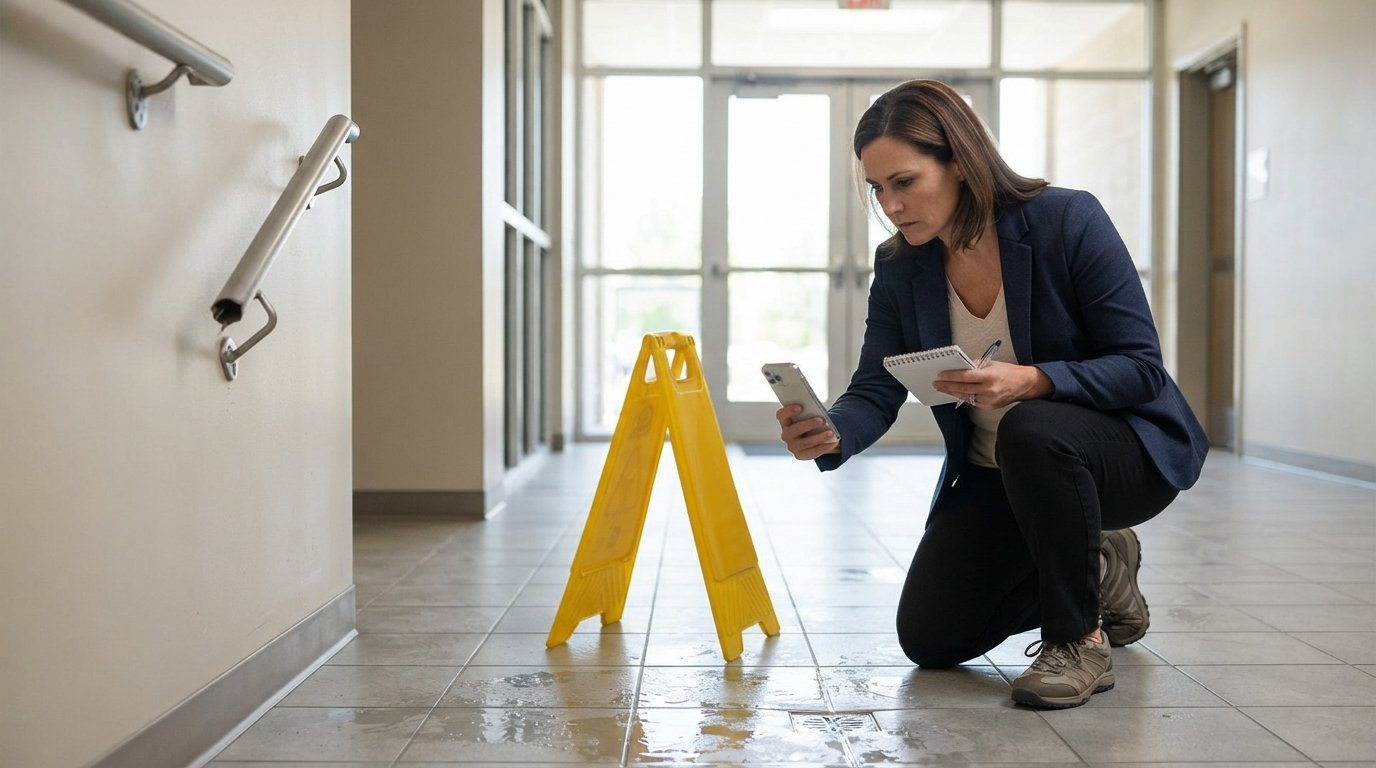
- Photograph everything. Capture wide shots of the location, close-ups of the hazard (wet floor, uneven pavement, torn carpet, missing handrail), your footwear, and any visible injuries. Take photos from multiple angles and include something for scale, such as a coin or your hand.
- Identify witnesses. Get names, phone numbers, and email addresses from anyone who saw the fall or the condition of the area. Ask if they would be willing to provide a written statement later.
- Seek medical care and follow the plan. See a doctor or urgent care the same day if possible. Describe the accident clearly and report every symptom, even ones that seem minor. Attend all follow-up appointments and follow treatment recommendations.
- Create a personal injury journal. Write down what happened, when, where, and how you felt, then update it regularly with pain levels, sleep problems, missed work, and daily limitations.
These five steps form the foundation of a credible claim. The rest of this article expands on each one, explains the legal reasoning behind it, and covers mistakes that routinely sink otherwise valid cases.
Photographic and Video Evidence: What to Capture and How
Photos are the most persuasive evidence in most slip and fall claims because they are hard to dispute. A clear image of a puddle, a torn carpet edge, or a missing caution sign can establish negligence on its own. Take more pictures than you think you need. Digital storage is cheap, and you can always delete duplicates later. If you are physically unable to take photos, ask a bystander or family member to do it immediately.
Video can be even stronger, especially if you can record the hazard from several angles or capture the general condition of the property. Some phones automatically attach timestamps and location data, which helps verify when and where the images were taken. Do not edit or filter the photos. Keep the originals and back them up to cloud storage or email them to yourself so they cannot be lost if your phone is damaged or replaced.
Also consider what other cameras may have recorded the incident. Many businesses, apartment complexes, and parking garages have surveillance systems. Footage is often overwritten within seven to thirty days, so send a written preservation request to the property owner or manager as soon as possible. A short letter stating the date, time, and location of the incident, and asking that all video be preserved, can make the difference between having proof and having nothing.
Medical Records and the Injury Documentation Timeline
Medical records do more than prove you were hurt. They establish the severity of your injuries, the treatment required, and the link between the accident and your current condition. Insurers scrutinize gaps in treatment, so consistency matters. If you miss appointments or stop going to physical therapy, the adjuster will argue that you must not be seriously injured.
Keep a folder, physical or digital, with every medical document you receive. This includes emergency room records, doctor's notes, imaging reports, prescriptions, physical therapy summaries, and bills. If you receive a patient portal, download the records regularly rather than assuming they will always be available. When you speak with a new provider, tell them exactly how the injury occurred and report all symptoms, including headaches, dizziness, back pain, or anxiety that may not seem directly related to the fall.
Some injuries, such as traumatic brain injuries, herniated discs, and complex regional pain syndrome, do not show up immediately. Continuing medical care creates a record that captures these delayed symptoms. If you are considering a claim, a free case evaluation can help you understand how medical documentation affects the value of your case and whether you may need an expert medical opinion later.
Witness Statements and Incident Reports
Witnesses can confirm what you may not be able to prove alone: that the floor was wet, that the lighting was poor, or that the property owner knew about the hazard and did nothing. Collect contact information from everyone who saw the fall, including employees, customers, and passersby. Ask each person to write down what they saw in their own words, sign and date it, and include their contact details. Even a short text message or email can serve as an informal statement if a formal one is not possible.
Incident reports are a double-edged sword. On one hand, a report creates an official record of the event. On the other hand, it is written by the property owner or an employee and may contain inaccuracies or statements that minimize the hazard. If you are asked to give a statement, stick to the facts: what happened, where, when, and what you observed. Avoid guessing about the cause or apologizing for the fall. Request a copy of the report, and if you are not given one, follow up in writing.
Keep in mind that anything you say to the property owner, manager, or insurer can be used later. You are not required to give a recorded statement to an insurance adjuster, and you should generally decline until you have spoken with an attorney. A complimentary case assessment can help you decide how to respond to these requests without harming your claim.
Building a Personal Injury Journal That Holds Up
A personal injury journal is one of the most underrated pieces of evidence in a slip and fall case. It shows the human side of your injury: how it affected your sleep, your mood, your ability to work, and your relationships. Adjusters and juries respond to specific, consistent details. Entries like "pain at 7 out of 10, could not drive my kids to school, had to cancel physical therapy because I could not sit in the car" are far more persuasive than a general statement that you are hurting.
Write in your journal at least once a week, and more often if your symptoms change. Include the date, your pain level, medications taken, side effects, missed work or social events, and any new limitations. Do not exaggerate and do not minimize. Consistency is what makes the journal credible. If you keep a digital journal, back it up. If you keep a paper journal, store it in a safe place and avoid rewriting or editing entries, since alterations can raise questions about authenticity.
The journal also serves a practical purpose for your attorney. It provides a ready-made summary of your damages, including pain and suffering, which can be difficult to quantify without documentation. If your case proceeds to negotiation or trial, the journal becomes a powerful exhibit that supports the non-economic portion of your claim.
Common Mistakes That Weaken a Slip and Fall Claim
Even people with strong cases sometimes damage their own claims through small, avoidable errors. Being aware of these pitfalls helps you protect the evidence you have worked to collect. One of the most common mistakes is posting about the accident on social media. Insurers routinely review public profiles, and a photo of you hiking or dancing can be used to argue that your injuries are not as serious as you claim. The safest approach is to stay off social media entirely until your case is resolved.
Another mistake is giving a recorded statement to an insurance adjuster without preparation. Adjusters are trained to ask questions that seem harmless but are designed to lock you into a version of events or to minimize the hazard. You have the right to decline, and doing so is almost always in your interest. Similarly, signing a broad medical release gives the insurer access to your entire medical history, including records unrelated to the accident. A limited release is usually sufficient.
Delays in treatment, missed appointments, and gaps in documentation also weaken claims. If you cannot afford treatment, ask your provider about payment plans or contact a legal professional about options. Finally, accepting a quick settlement offer before you know the full extent of your injuries is a frequent and costly error. Once you sign a release, you cannot reopen the claim, even if new symptoms appear later. A free case evaluation can help you understand whether an offer is fair before you commit.
Working With an Attorney and Requesting a Free Case Evaluation
You are not required to hire an attorney after a slip and fall, but having one can make a significant difference in how your evidence is preserved, presented, and valued. Attorneys know how to send spoliation letters to preserve video and maintenance records, how to take witness statements, and how to negotiate with insurers who routinely undervalue claims. They also understand the local rules and deadlines that apply in your state.
If you are considering legal help, start with a free, no-obligation case evaluation. FreeLegalCaseReview.com connects injured people with qualified personal injury and mass tort attorneys through a patented selection process, and there is no cost or obligation to request a review. You can explain what happened, share the documentation you have gathered, and get a clear picture of your options. For more general legal information and case analysis, you can also explore resources like LegalCaseReview, which publishes commentary on personal injury law and notable litigation.
Before your evaluation, organize your evidence: photos, medical records, witness contacts, the incident report, and your journal. The more complete your file, the more useful the evaluation will be. Even if you decide not to pursue a claim, the documentation you have built will help you manage your health and finances with a clearer understanding of what happened and what comes next.
Documenting a slip and fall is not about building a case overnight. It is about capturing small, specific details while they are still fresh: the wet floor, the missing sign, the doctor's note, the day you could not get out of bed. Taken together, those details tell a story that insurers and courts can understand and respect. Start today, keep your records organized, and do not hesitate to seek a free case evaluation when you are ready to take the next step.