
DUI Checkpoint Refusal Rights: What Drivers Can Decline
Understand DUI checkpoint refusal rights and what drivers can decline. Call (833)-248-4565 for a free, confidential case review today.

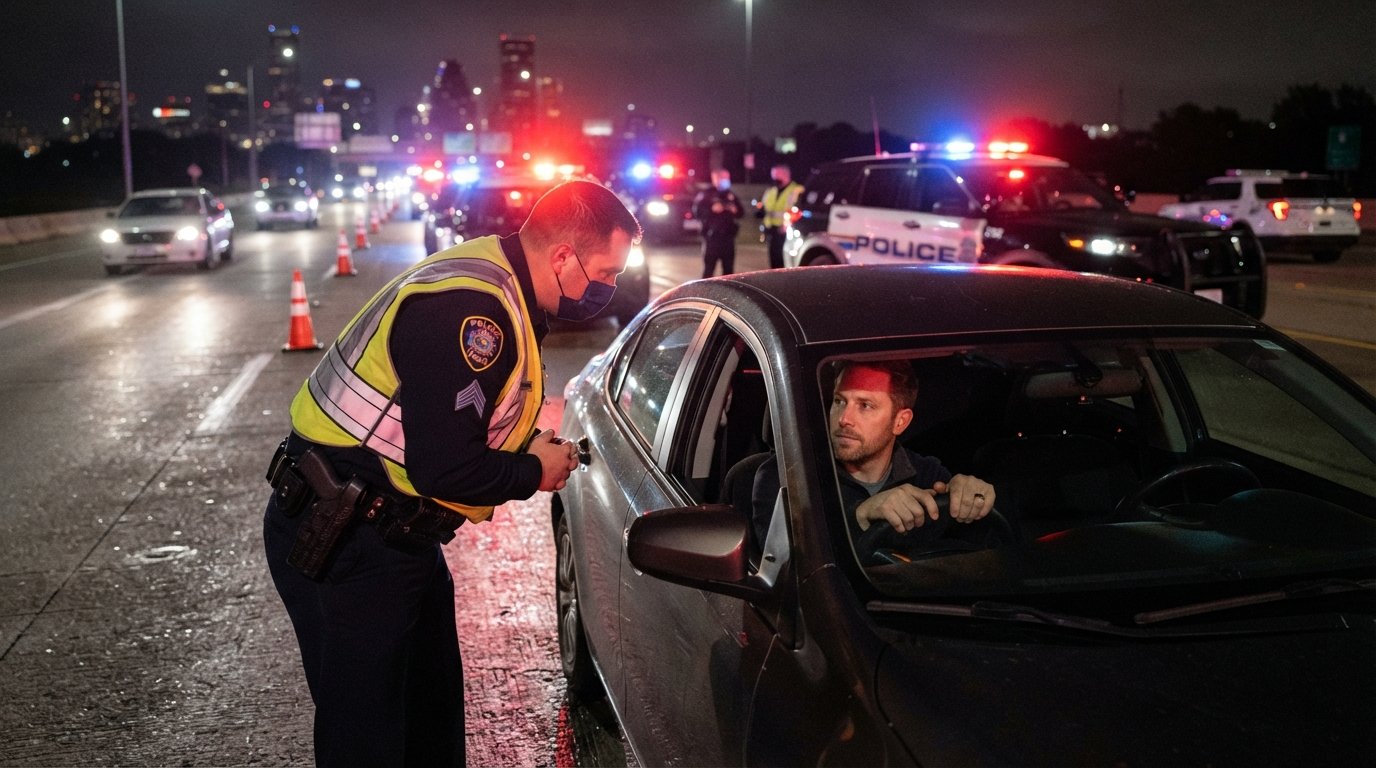
Blue lights flare ahead, traffic slows to a crawl, and an officer leans toward your window. The question every driver faces at a sobriety checkpoint is simple on its surface: what must I do, and what can I refuse? The answer is not uniform, and it changes dramatically depending on whether you are at a checkpoint or a lawful traffic stop, and whether the request involves a field sobriety exercise or a chemical breath test. Understanding your dui checkpoint refusal rights and what drivers can decline is not a loophole; it is basic legal literacy that can prevent a bad night from becoming a life-altering conviction.
This guide walks through the exact boundaries of police authority at checkpoints, the consequences of refusing chemical tests under implied consent laws, and how refusal evidence is actually used in court. It also explains why the earliest hours after an arrest matter more than most people realize, and how a free case evaluation can clarify your options before you ever set foot in a courtroom.
What Officers May Ask at a Checkpoint Versus a Lawful Stop
A sobriety checkpoint is a roadblock where officers stop vehicles according to a neutral formula, such as every third car, to look for signs of impairment. The United States Supreme Court upheld these stops in Michigan Department of State Police v. Sitz, but the ruling came with limits: the checkpoint must serve a legitimate public safety purpose, and the officers must follow a neutral plan rather than choosing cars arbitrarily. That legal framework shapes what an officer can and cannot do at the window.
At a checkpoint, the officer's first job is the initial visual and olfactory scan. They may ask for your license and registration, ask where you are coming from and where you are going, and observe your eyes, speech, and coordination. They may ask whether you have been drinking. They may not order you out of the car or search your vehicle without individualized suspicion or consent. The difference between a checkpoint and a lawful stop is important: once an officer observes specific facts suggesting impairment (slurred speech, an open container, the odor of alcohol), the encounter shifts from a brief checkpoint detention into an investigative stop with broader authority.
That shift is where many drivers get confused. Declining to answer casual questions is generally within your rights, but refusing to provide a license and registration when lawfully detained can create its own problems. The practical takeaway is to stay calm, keep your answers short, and understand that the checkpoint itself is a limited encounter. If the officer escalates, the legal basis for that escalation becomes a key issue that a defense attorney can challenge.
Implied Consent Laws and the Penalties for Refusing Chemical Tests
Every state has an implied consent law. The concept is simple: by driving on public roads, you are deemed to have consented in advance to a chemical test of your breath, blood, or urine when an officer has reasonable grounds to believe you were driving impaired. When you refuse, you are not simply exercising a right; you are triggering administrative penalties that operate separately from any criminal case.
The penalties vary by state, but the pattern is consistent and severe. Common consequences of a first refusal include:
- Suspension of your driver's license for a set period, often six months to one year, sometimes longer for repeat refusals
- Mandatory ignition interlock requirements or restricted driving privileges in some states
- Administrative fines and hearing costs that are separate from criminal court fees
- Enhanced criminal penalties if you are later convicted of DUI, with refusal treated as an aggravating factor
These administrative penalties typically move faster than the criminal case. In many states, you have only a short window, sometimes as little as seven to ten days from the arrest, to request an administrative hearing to challenge the license suspension. Miss that deadline and the suspension may take effect automatically regardless of what happens in criminal court. This is one of the most common and avoidable mistakes drivers make after a DUI arrest, and it is a strong reason to speak with counsel as soon as possible.
It is also important to separate the types of tests. Field sobriety exercises (walk and turn, one leg stand, horizontal gaze nystagmus) are not chemical tests. Refusing those exercises generally carries no automatic license penalty, though the officer may treat the refusal as a factor in deciding whether to arrest. Refusing a breath or blood test after arrest is a different matter entirely, and that is where implied consent penalties attach.
Declining Field Sobriety Exercises Versus Breath Tests
The distinction between field sobriety exercises and chemical tests is the heart of dui checkpoint refusal rights and what drivers can decline. Field sobriety exercises are physical coordination tests performed at the roadside. They are voluntary in the sense that no statute imposes an automatic license suspension for declining them. However, declining them does not come without risk: prosecutors frequently argue that a refusal to perform the exercises shows consciousness of guilt, and officers may use the refusal as part of the probable cause narrative for arrest.
Chemical breath tests are governed by implied consent and carry statutory consequences for refusal. This is why the phrase "refuse the breath test" is misleading advice. You can decline, but the law will respond with administrative penalties and the prosecutor may comment on the refusal at trial in many jurisdictions. Blood tests raise additional constitutional issues, and some states require a warrant before a blood draw can be compelled. The legal landscape here is genuinely state-specific, which is why generic internet advice is a poor substitute for a review of your situation by an attorney licensed in your state.
If an officer asks you to step out of the vehicle and perform exercises, you are not required to do so in the way television portrays. You can politely decline. If you are arrested and asked to submit to a breath test, the decision carries legal weight that extends beyond the roadside. Understanding which request you are facing, and what statute applies, is the single most useful piece of knowledge a driver can carry into a checkpoint encounter.
How Refusal Evidence Is Used at Trial
Prosecutors do not treat a refusal as a neutral event. In many states, the refusal to submit to a chemical test is admissible at trial as evidence of consciousness of guilt. The logic the prosecution advances is that an innocent driver would welcome the chance to clear their name. Defense attorneys counter that a refusal may reflect confusion, fear, or a mistaken belief about rights, not guilt. The admissibility rules and the permitted inferences vary significantly from state to state, and appellate courts have drawn fine lines around how juries may be instructed.
Refusal evidence also interacts with the probable cause analysis. If the officer lacked reasonable grounds to request the test in the first place, the refusal may be excluded or its use limited. Defense counsel often scrutinizes the checkpoint's operational plan, the officer's training and observations, the calibration and maintenance records for breath testing devices, and the chain of custody for blood samples. Each of these can become a basis for suppressing evidence or undermining the prosecution's case. For a deeper look at how defense counsel approaches these issues, see this guide on how DUI defense lawyers help your case.
Beyond the criminal case, refusal evidence can influence administrative license hearings, insurance outcomes, and even plea negotiations. A prosecutor who knows the refusal is admissible may offer less favorable terms. An attorney who can frame the refusal in a credible way, or challenge the underlying stop, may change the entire trajectory of the case. This is why the trial strategy around a refusal begins long before jury selection.
Why Early Defense Review Changes Outcomes Before the Court Date
The most consequential decisions in a DUI case happen in the first days after arrest, often before the defendant has spoken to anyone qualified to advise them. The deadline to request an administrative hearing on the license suspension is short. Body camera footage and dispatch records may be overwritten or harder to obtain later. Witness recollections fade. The checkpoint operational plan and the officer's notes are freshest in the immediate aftermath, and a timely request for preservation of evidence can make the difference between a strong defense and a thin one.
An early review also clarifies which rights were actually in play. Was the checkpoint lawfully established? Did the officer have individualized suspicion before ordering field exercises? Was the request for a chemical test supported by probable cause? Were you advised of the consequences of refusal as your state requires? These questions are answerable only with the specific facts of your encounter, and the answers shape whether a motion to suppress, a challenge to the administrative suspension, or a negotiated resolution is the right path.
For drivers injured in a crash connected to a DUI stop, or facing related civil and criminal exposure, the coordination between personal injury and DUI defense matters. Resources such as AutoInjuryAccident help people involved in car crashes and DUI-related incidents request a free, confidential case review with participating attorneys, which can be a useful starting point for understanding the civil side of the picture while the criminal case unfolds. Fault rules, insurance deadlines, and statutory time limits vary by state, so early clarity is valuable.
A free case evaluation through FreeLegalCaseReview.com is designed to give you that clarity without obligation. The platform is not a law firm and does not provide legal advice, but it connects people facing DUI charges and related civil claims with attorneys who can review the facts and explain the options. The conversation is confidential, and there is no cost to request it. For many drivers, that first conversation is what turns a confusing, frightening encounter into a set of concrete decisions with a plan behind them.
Practical Steps to Protect Your Rights at a Checkpoint
Knowing the law is only half the equation; the other half is conduct at the window. The following steps reflect widely accepted guidance for a checkpoint encounter and are worth reviewing before you need them:
- Slow down, signal, and comply with the officer's directions. Erratic driving gives the officer individualized suspicion before you say a word.
- Provide your license and registration when asked. This is a lawful request during a valid checkpoint detention.
- Keep answers brief and polite. You are not required to volunteer information about where you have been or how much you have had to drink.
- If asked to perform field sobriety exercises, you may decline, but understand the officer may treat that as a factor in the arrest decision.
- If arrested and asked for a chemical test, recognize that implied consent penalties apply. Ask to speak with an attorney as soon as practicable and do not resist the arrest process.
After the encounter, write down everything you remember as soon as possible: the time, the location, the officer's name and badge number, the questions asked, and the exact words used. This contemporaneous record is often more valuable than a recollection reconstructed weeks later. Preserve any paperwork you receive, including the citation, the administrative suspension notice, and any chemical test refusal form. These documents contain deadlines that govern your next steps.
Finally, resist the urge to resolve the matter alone. DUI law is a patchwork of state statutes, local checkpoint policies, and evolving case law. Advice that is correct in one state can be wrong in another, and the stakes include license loss, fines, insurance rate increases, and in some cases jail time. A consultation with counsel is not an admission of guilt; it is a way to understand the actual risks you face and the defenses available to you.
Checkpoints are designed to be brief, but the legal consequences of what happens at the window can last for years. Knowing what you can decline, what you cannot, and when to ask for help is the foundation of a smart response. If you are facing a DUI charge or a related civil claim, request a free, confidential case review and get the facts specific to your state before the deadlines start to close.